
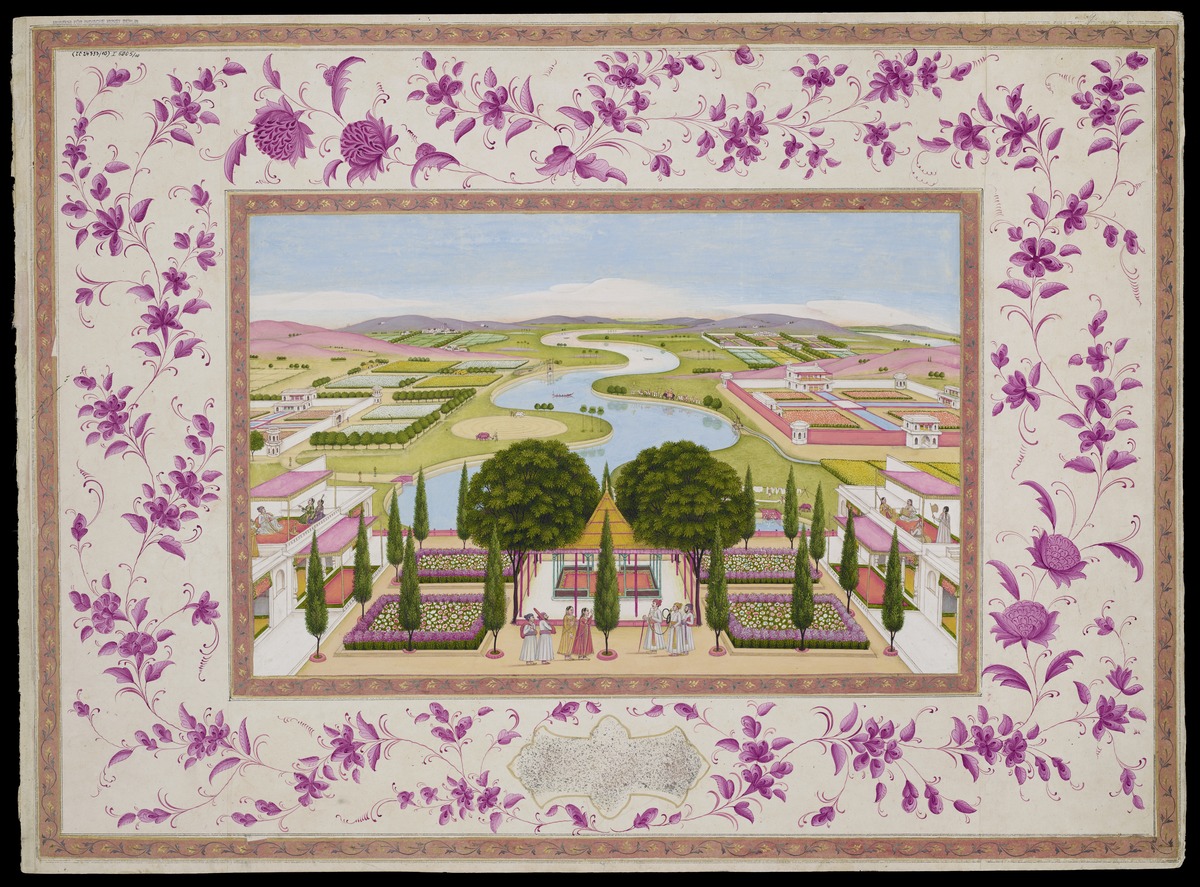
Palace garden in a river landscape. Miniature painting. Commissioned by Antoine Polier. Attrib. Mihr Chand. Collection: State Museums of Berlin. Museum für Asiatische Kunst / Martin Franken
Did you notice her? Singing on the left, accompanied by a tambura player? Or the musicians on the right, playing another tambura and dhol? What is it about things being very small – the details of their gold jewellery, the braiding on each peshwaj, the women’s sideways glances at one another – that makes them seem miraculous? In this context, commissioned by a wealthy European (Antoine Polier) to show or gift to his friends and benefactors, I can’t help but feel sceptical about the pleasure taken in a painting that represents India as if it were a toy theatre, a controllable, and controlled garden as stage, where the painter and the patron call the tune. At the same time, I am drawn in by the skill of the painter, and the delight in finding new understanding as I zoom in on the details. I almost couldn’t sleep, when after looking through a magnifying glass at another painting, I realised that the women in the background were playing the board game, pachesi. I know. Small pleasures. Or big pleasures in something very small, and of not much consequence.
I spent an enchanted afternoon backstage at the Museum für Asiatische Kunst in Berlin, with this album of paintings (I.5005), many of which show gardens and most of which show dance and music, often in combination, and often performed by women. As I looked, I was thinking about real women, too, and the extent to which this might, or might not, have represented their experience. The painting miniaturises the garden (and those in it); the garden miniaturises the realm (and those in it); the realm is a great deal messier, inevitably, often gloriously, often tragically and brutally.
The chapter on Antoine Polier and the women in his garden (Jawahar, Khwurd, possibly Khanum, possibly Durdanna, not to mention ‘the gift’ and other children) got so long I am late posting this. The paintings are not lies. But in miniature, one sees only surface perfection (like Gulliver, admiring the Lilliputians’ perfect skin).
Sancintya Mohini Simpson, a contemporary Australian artist with South Indian heritage, trained in the miniature traditions of Jaipur; drawing on this she has created paintings which depict labour rather than leisure or religious narrative. The viewer’s initial response to the ‘seductive and delicate’ depictions of South Asian indentured labour in the sugar plantations of Natal Durban gives way to a gradual recognition that a woman is hanging from a tree, another is bleeding on the ground – violence is present across the seemingly perfect landscape.
The floral framing of Chand’s miniatures gives less away.