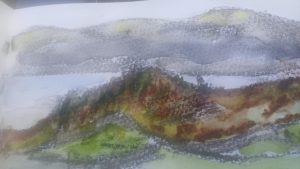
Some years back, I began to research Thomas Bushell, the creator of the Italianate waterworks, the ‘Enstone Marvels’. You can read here about the way that Bushell used these gardens to gain the ear of King Charles I, in August 1636 and to petition for the rights to take over the lease of the Mines Royal in Wales (granted January 1637). Although there is a lot of fun to be had with the eccentric Bushell, we should probably take him more seriously than I did at first. He certainly had some impact on the Welsh landscape, and he poured its riches into the Royalist cause during the Civil War.
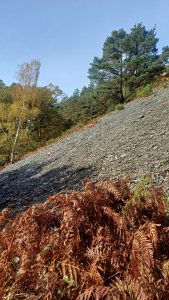
I wanted to know more about what happened in Wales, so I went to explore Tal-y-bont, the centre of his mining operations. There are still old workings there, spoil tips and an adit known as ‘Bushell’s level’, though it doesn’t tally quite with Bushell’s own description.
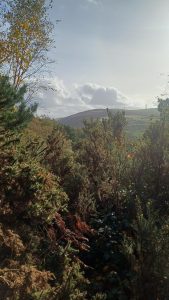
 Following up local information led me to Bushell’s place of residence in Wales, Park Bodvage (now Lodge Park), and to a rumour that he murdered his wife Isobel while living there. This rumour is preserved in Lives of the Engineers Vol 1, which comments on ‘Bushell’s Well, where he is said to have killed and thrown in his wife, and the people still believe that her headless corpse haunts the woods round the well’ (cited in The Cambrian News and Merionethshire Standard, 11th June 1880, ‘Queries’ p.3).
I think it unlikely. Ffynon Bushell is a shallow well, 18 inches deep. It is cut square into the rock, like the entrance to a mine or a cave. It is certainly the sort of structure one would expect from Bushell, with his liking for both grottoes and mines, but it would not be a good place to hide a body, and if he had wished to dispose of his wife, live or dead, he had access to multiple deep and flooded mine shafts.
In fact, Bushell and his wife seem to have been separated long before this, by Bushell’s own account in 1628. John Jordan notes that back at Enstone, church registers are completely missing between 1626 and 1654, due to the Civil War, so records of her death were likely lost (she must have died during this period, as Bushell was remarried in 1642). Bushell’s prompt departure from Wales seems to have been in order to support the King.
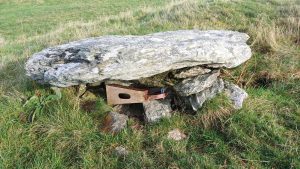
Between Tal-y-bont and the deer park at Tre’r-ddol, Taliesin’s grave is another questionable site (it’s a bronze age barrow). I was happy to see a small harp under it, though. I sang him ‘Now the day is over’, with apologies for doing it in the English language.